A Simple Spaced Repetition Revision Schedule for Students
Cramming works until it doesn't. Spacing out your revision is the easiest upgrade you can make to how you prepare.
Short answer
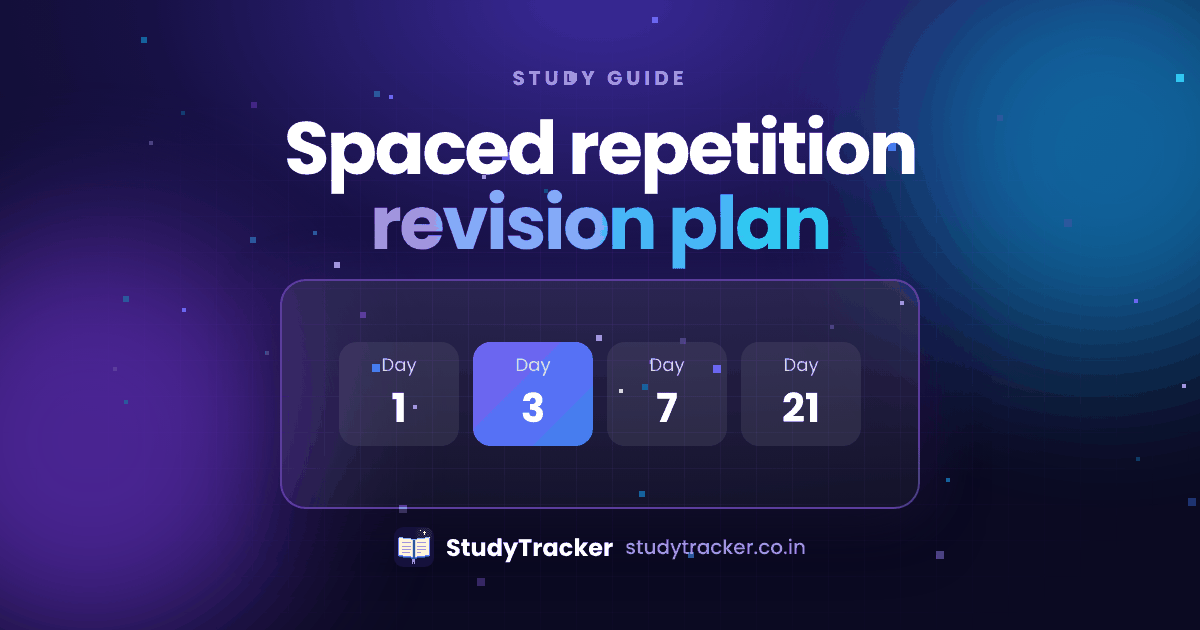
Spaced repetition means revising something again after longer and longer gaps. A simple plan for students is to revise a topic 1 day, 3 days, 7 days and 21 days after you first learn it, using active recall each time.
The forgetting curve in one paragraph
We forget new things fast unless we go back to them. Each review slows the forgetting, so the next gap can be longer. That's why five short reviews beat one long cram.
The 1-3-7-21 schedule
| Review | When | How long |
|---|---|---|
| Learn | Day 0 | Full study |
| Review 1 | Day 1 | 10 to 15 minutes of recall |
| Review 2 | Day 3 | 10 minutes of recall |
| Review 3 | Day 7 | 10 minutes of recall |
| Review 4 | Day 21 | 10 minutes of recall plus practice questions |
These gaps are a rule of thumb, not a law. Make them shorter if your exam is close, and longer if you have time.
Make it work in real life
- Put each review in your planner on the day you learn the topic.
- Use active recall at every review, not re-reading.
- If you forget a lot at a review, shorten the next gap for that topic.
Plan backwards from your exam
Take the exam date and subtract 21 days. Ask which chapters you must finish learning by then. Everything after that is review and practice. The exam countdown in StudyTracker keeps this in front of you.
Frequently asked questions
Is spaced repetition only for memorising facts?
It helps most with facts, formulas and definitions. It also helps with problem solving if you redo questions at spaced gaps.
What if I start late?
Squeeze the schedule to 1, 2, 4 and 7 days. A short spaced plan still beats pure cramming.