Short answer
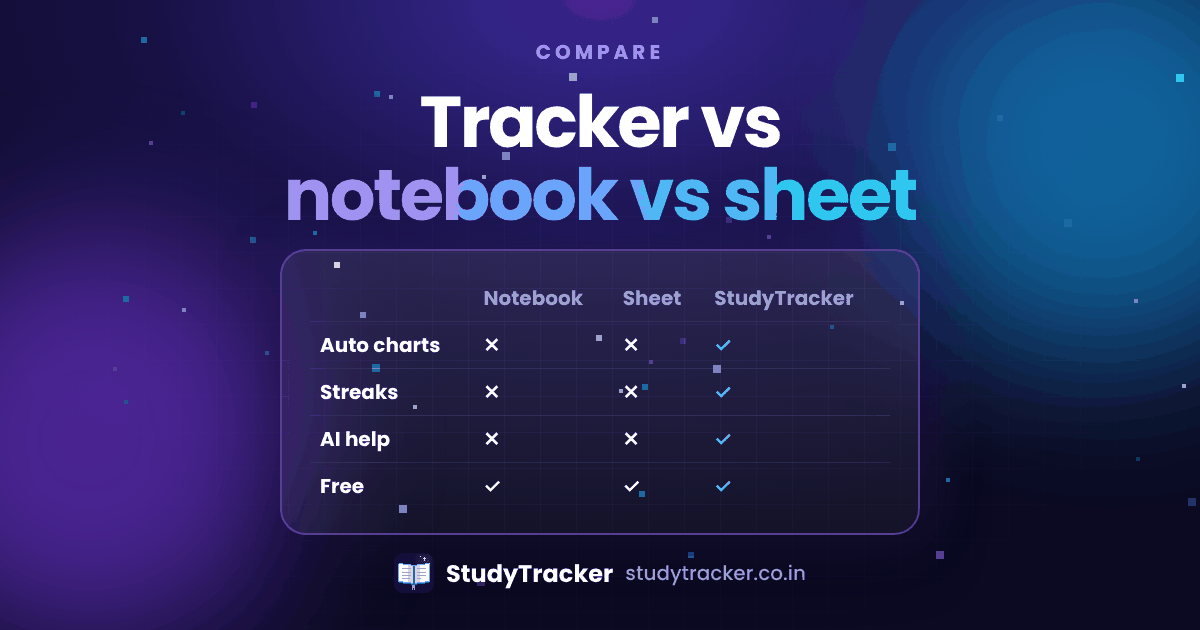
Pick the method you'll use every day. Paper is simple, spreadsheets are flexible and timer apps are quick. A study tracker like StudyTracker logs your time, draws the charts and adds revision tools, all for free.
| You need | Paper planner | Spreadsheet | Timer app | StudyTracker |
|---|---|---|---|---|
| Cost | Low | Free | Free or paid | Free |
| Time logged for you | No | No | Yes | Yes, by subject |
| Charts and trends | By hand | You build them | Limited | Built in |
| Exam countdown and planner | By hand | By hand | Rare | Built in |
| AI help for GSEB | No | No | No | Yes, in English and Gujarati |
| Teacher dashboard | No | Make your own | No | Yes |
| Works offline | Yes | Depends | Depends | Needs internet to sync |
When paper is better
If screens distract you, a notebook for planning and a kitchen timer is a fine setup. Just write down the time you really studied, not the time you meant to.
When StudyTracker is better
When you want real numbers without extra work, charts that show the subjects you're skipping, and revision tools like flashcards, a planner and AI next to the timer.
Frequently asked questions
Is a paper planner or an app better for studying?
Either works if you use it every day. Paper is simple and has no distractions. An app times your sessions and draws the charts for you. Many students use both.
Why not just use a spreadsheet?
A spreadsheet is flexible, but you have to set it up and type everything in by hand. A study tracker records your time as you study and builds the charts for you.